costes · Editorial pillar Published 8 Apr 2026 min read
Solar Panel ROI Málaga 2026: Is It Really Worth It?
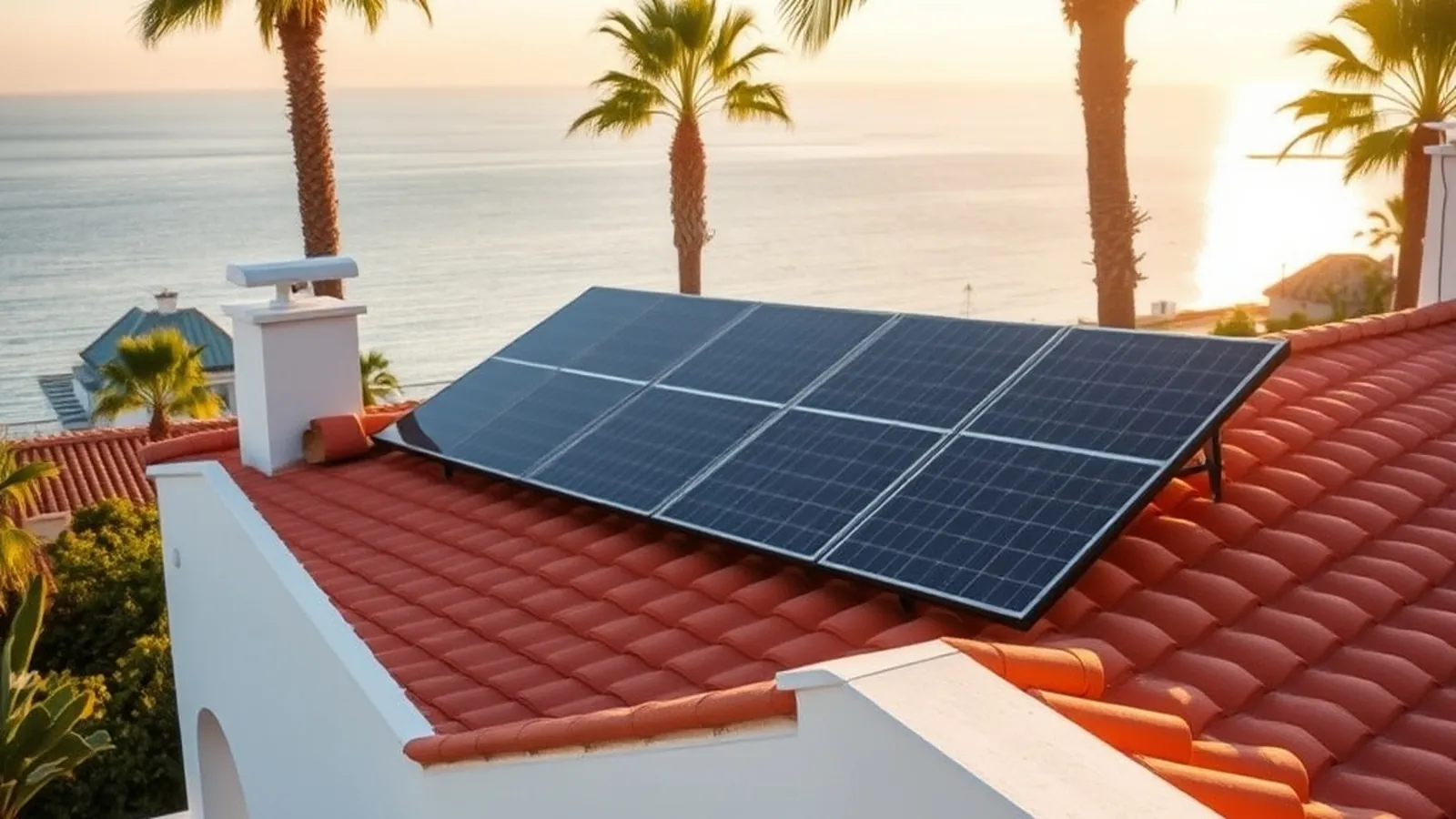
Real Málaga 2026 numbers: 8-12% ROI, 4-7 year payback with subsidies, honest 25-year projection — no inflated promises.
Yes, installing solar panels in Málaga in 2026 is worth it. But we want to be honest about the numbers. Many websites inflate calculations using 0.22 €/kWh as the electricity price. We use 0.13 €/kWh (real 2026 indexed market) per OMIE OMIE · April 2026 . The figures are more modest, but they are what you’ll really encounter.
Numbers are estimates from public PVGIS, OMIE and RDL 7/2026 sources. Translations may need a fact-check pass — see our calculator for figures using your real consumption.
The real numbers — uninflated
Base scenario: 5 kWp in Málaga capital, no battery, average family consumption of 4,500 kWh/year, instantaneous self-consumption of 40% (realistic with smart appliances).
| Parameter | Value | Source |
|---|---|---|
| Annual production | 8,260 kWh | PVGIS API: 5 kWp × 1,652 kWh/kWp |
| Direct self-consumption (40%) | 3,304 kWh | Conservative estimate for typical family |
| Surplus to grid (60%) | 4,956 kWh | What you don't use is exported |
| Self-consumption savings | €430 | 3,304 × 0.13 €/kWh (real tariff) |
| Surplus compensation | €347 | 4,956 × 0.07 €/kWh (fixed retailer tariff) |
| Total annual savings | €777 | Without subsidies |
| Installation cost | €6,000 – €7,500 | Verified market average — 3+ installers |
| Gross payback | 7.7 – 9.7 years | Depending on installation price |
Data verified directly against PVGIS 5.2 (European Commission, JRC) and the OMIE wholesale market.
Real annual savings (no subsidies)
777 €/year
With 40% IRPF deduction
If you meet the requirements of DA 50 s. 2 (energy certificate before/after, ≥30% reduction in non-renewable primary energy — see our honest IRPF guide), regulated by RD-L 7/2026:
| Parameter | Without subsidy | With IRPF 40% |
|---|---|---|
| Installation cost | €6,000 | €6,000 |
| IRPF DA 50 s. 2 deduction | — | −€2,400 |
| Effective cost | €6,000 | €3,600 |
| Annual savings | €777 | €777 |
| Payback | 7.7 years | 4.6 years |
With IRPF + IBI (Torremolinos example)
Torremolinos has a 50% IBI bonus for 3 years (verified against Fundación Renovables). If your base IBI is ~€700/year, you save €350/year × 3 years = €1,050 additional:
| Parameter | Value |
|---|---|
| Effective cost post-IRPF | €3,600 |
| IBI 50% × 3 years savings | −€1,050 |
| Real net cost | €2,550 |
| Annual electricity savings | €777 |
| Payback | 3.3 years |
25-year projection
Panels last at least 25 years (manufacturer performance warranty: 80-87% at year 25). If electricity prices rise 3% annually (European historical average), your savings grow each year:
| Year | Annual savings (3% inflation) | Cumulative savings |
|---|---|---|
| Year 1 | €777 | €777 |
| Year 5 | €875 | €4,125 |
| Year 10 | €1,014 | €8,907 |
| Year 15 | €1,175 | €14,451 |
| Year 20 | €1,362 | €20,878 |
| Year 25 | €1,579 | €28,329 |
Net 25-year benefit (with IRPF)
~24,700 €
When it’s NOT worth it
Let’s be honest. There are situations where installing solar is not the best option:
If in doubt, use our solar calculator with real PVGIS data for your specific municipality — it’s the fastest way to know if it’s right for you. For raw price ranges by area, our town-by-town Costa del Sol price comparison is a useful cross-check.
The factor almost no one mentions: future electricity prices
Electricity prices in Spain have risen on average 3-5% annually over the last decade. In 2025 they rose 15.5% per FACUA data. If this trend continues:
| Horizon | Estimated price kWh | Increase vs today |
|---|---|---|
| Today (2026) | 0.13 €/kWh | Base |
| 2031 (5 years) | 0.15 €/kWh | +16% |
| 2036 (10 years) | 0.17 €/kWh | +34% |
| 2041 (15 years) | 0.20 €/kWh | +56% |
| 2046 (20 years) | 0.23 €/kWh | +81% |
Each electricity price increase automatically increases your savings because you produce your own energy at zero cost after recovering the investment. Solar energy is a hedge against energy inflation.
Compared to other investments
| Investment | Annual return | Risk | Liquidity |
|---|---|---|---|
| Bank deposit | 2-3% | Low | High |
| Stock market (S&P 500) | 7-10% (historical) | Medium-high | High |
| Solar panels (Málaga) | 8-12% | Low | Low |
| Rental property | 4-6% | Medium | Low |
The key advantage of solar: the sun rises every day and production is predictable. Versus a stock investment, solar is much more stable. Versus a rental property, solar has no risk of unpaid rent or damages. The only downside is liquidity: you can’t “withdraw” your installation to recover cash quickly.
Preguntas frecuentes
Why are my numbers lower than other websites?
Because we use real 2026 electricity prices (0.13 €/kWh indexed) and a realistic surplus compensation rate (0.07 €/kWh), not the 0.22 € or 0.15 € other sites use to inflate. Real numbers are more modest but honest.
How does it compare to investing in the stock market?
Roughly similar (8-12% annual), but with much lower risk. Solar production is predictable (the sun rises every day), while the stock market can drop 30% in a bad year. The only 'risk' for solar is electricity prices falling — which has not happened in 20 years.
Is it worth adding a battery to earn more?
Economically, almost never. A 10 kWh battery adds €4,500-€6,500 in cost but only saves about €170-€200/year extra (you self-consume at €0.13 what you used to export at €0.07). Battery-only payback: over 20 years, longer than its 10-15-year life. Battery only makes sense for backup against blackouts or low self-consumption profiles.
What if I move before recouping the investment?
The installation stays with the house and increases its sale value. Studies show homes with solar sell 3-8% higher than equivalent homes without. If payback is 5 years and you sell at 3, you don't lose investment — you recover it in the price.
What if electricity prices drop significantly?
Your savings would be smaller but still positive. For your installation NOT to be profitable, prices would need to drop to 0.05 €/kWh sustainably — something that has not happened in 20 years and goes against the European market trend.
Next steps
- Use our solar calculator with your real kWh consumption.
- Read our installation cost guide for full pricing breakdown.
- See IRPF deduction details before assuming you qualify.
- Contact us for a personalized quote — Solar Master is honest about both the numbers and the limits.
Verified sources
Every figure in this article links to its primary source. Verified 30 Sept 2026.
-
PVGIS solar production Málaga 1652 kWh/kWp/year
-
OMIE wholesale electricity market price 2026
-
RD-L 7/2026 IRPF deduction DA 50 s. 2 40% energy efficiency, works finished by 31-12-2026
-
Fundación Renovables IBI bonus Torremolinos
━ End of article ━
Data verified against primary sources: PVGIS · BOE · BOJA · OMIE · Fundación Renovables
Last verification: 30 September 2026